

"Just a shadow of Soviet Union" — US media persuade their readers that NATO prevailes over Russia (PHOTOS, VIDEO)
29.06.2016 - 17:38
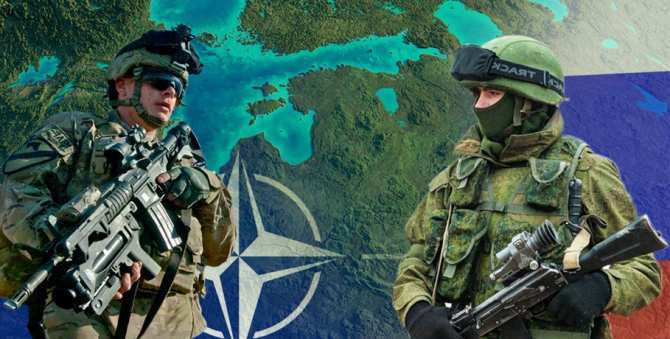
Author of an article in American ‘The Week’ claims that Russia is “just a shadow of former Soviet Union” and it can hardly be NATO’s rival. Let’s look closer at his reasoning which is lie and facts spinning.
June 16 American ‘The Week’ published an article devoted to a possible scenario in case of escalation between Russia and the West and transition into active armed conflict.
The article was titled “How a Russia vs. NATO war would really go down” and its author Kyle Mizokami shares his ideas concerning possible armed stand-off between Moscow and North Atlantic club.
American Japanese, “a wide range expert”
Author of the article is ethnic Japanese livivng in San-Francisco (USA), he writes not only for The Week but also for a whole range of American and Japanes editions.
His Twitter account says that he is Contributing Editor at PopMech, he lists such editions as The National Interest, Foreign Policy, The Diplomat, The Daily Beast, Japan Times among those he works for.

Sphere of his interests is defence and security throughout the world, he pays great attention to Asia and Japan (but still he eagerly voices his “expert opnion” on Russia as we may see). In 2009 he’s become a co-founder of Japan Security Watch blog dedicated to defence and security matters, he also owns Asia Security Watch blog.

«...Just a shadow of Soviet Union»
Despite Mizokami’s artice has no specific analytical value it deserves scrutiny as author’s opinion is shared by quite a lot of the Europeans and people across the Atlantics.

The author is discontent with “a flurry of news reports that Putin's Russia could «steamroll» NATO forces in just five days, winning a quick victory in the Baltics that would drag Estonia, Latvia, Lithuania — and perhaps even Poland — kicking and screaming behind a new Iron Curtain”.
Mizokami assures his readers that modern Russia is just “a shadow of former Soviet Union” and can hardly be a rival for North Atlantic club.
The author admits that should armed conflict occur the Russian side would have certian advantages, still the list of them is not very long according to him.
The war would take place right on Moscow's doorstep, where it can marshal forces from across the country for an attack.
Russia's supply lines would remain relatively short — 150 miles from the border at the most — which is good because logistics are not her strong suit. And Russia would have the element of surprise.
However in this short list of advantages the author counts only the objective ones created by nature and geography but he did not count any of the subjective factors created by the Russian people, first of all by the Russian scientists, engineers and the military.
Still the author dwells on what he believes to be “significant weak points”
To dispel a myth of modern and effective Russian army the author starts with a complete fail connected with modern Russian history knowledge (which is not unique for Western journalists, they are not bothered with studying Russian realias as a rule):
Most Soviet military units were based on Russian soil, and when the socialist regime went away in 1991, Soviet units became Russian ones, with the same personnel and the same equipment. That's just as well, because Russia then fell into two decades of economic stagnation. Heavy, expensive equipment wasted away.
Were Russian soldiers fed with dog food?
And then Mizakami creepingly passes on to blatant lie dishonouring Russian soldiers and officers.
In 1990s they really “lived on starvation budget” and they really lived “in poor conditions” but then we read “and even just three years ago Russian forces in the Far East were reportedly living in poor conditions and being fed rotten food — or even dog food” (the author means that Russian MoD bought dog food intentionally) . And that’s the moment we know he’s spinning the facts and lies.
The point is the author refers to media reports of a single egregious case when food storage chief of the military unit № 3411 in Chuguyevka, Primorskiy Kray Vyacheslav Gerzog bought dog food cans and labeled them as “boiled beef” because he knew of canned beef shortage at his food storage.
However inspection revealed this monkey business and dog food did not reach soldiers’ tables.
This happened in 2011. This single case was investigated and storage chief was accused of negligent performance of duty and abuse of official position.
But Mizokami deliberately twists facts hoping that his audience is not going to dig into the “evidences” .
As a result of such lies most of the readers get a feeling of superiority towards the Russian military with a stab of pity — not the feeling which should emerge when one thinks of “Russian army”.
Russian army makeover – is it going or not?
In 2014… Russia embarked on an ambitious plan to update its armed forces. The Russian military would also receive modern equipment to replace aged-out Soviet hand-me-downs. Russia launched an ambitious program to go from 10 percent modern military equipment to 70 percent modern equipment by 2020, at a cost of $720 billion. That program was never realized.
Just two years later, plummeting oil prices and sanctions imposed by the West after the annexation of the Crimea has once again sent the Russian economy — and defense budget — into a tailspin.
New combat equipment such as the T-14 Armata tank andPAK-FA stealth fighter have had their purchase numbers cut to token amounts. The old equipment is going to have to soldier on, – Mizokamy claims.
That’s where we should stop and look carefully at a Russian army modernization program leaving apart controversial question of Western sanctions’ influence on Russian economy slowdown.
Country’s budget provided huge amounts (20 trillion rubles) for army modernization which started not in 2014 but three years before — in 2011. But these amounts were allocated at once and extra financing was not planned.
«…I would like to say that we have 20 trillion which we allocated and almost 3 trillion (2,8 trillion, may be a bit more) — for military industrial complex reequipment…» — then prime-minister Vladimir Putin said in Komsomolsk-na-Amure on 20th of February 2012 at a conference dedicated to military industrial complex modernization program for the period till 2020.
The spending and application of funds are gradual and stepwise according to the program so neither economy slowdown, Crimea reunification with Russia nor Western sanctions have no significant influence over this process. .
By this day i.e. at the first stage of the program one third of the allocated funds was spent. They were spent on experimental and development work, on research for new generation weaponry creation.
The left funds i.e. two thirds of 20 trillion will be spent on serial production of tried and successful specimen of armoured vehicles, aviation, naval wepaons, antiaircraft-missile weaponry, artillery and other weapons as well as individual protective gear, tactical gear, small weapons and close combat weapons.
Procedure and terms of program implementation are not violated altogether which has been recognized by Russia military auhorities more than once. Vladimir Putin rated armed forces modernization program highly at National Defence Centre of Russia March 11 2016 at military products acceptance day.
He underlined that defence industry has met the commitments and most of military hardware had been supplied to the armed forces in time and in full extent.
According to Vladimir Putin “by the end of 2015 armed forces received about 4000 weaponry and military hardware advanced models which define a new image of Russia’s modern army.
There are 96 planes, 81 helicopters, 2 multipurpose submarines, 152 antiaircraft-missile complexes, 291 radars, more than 400 units of artillery and armoured vehicles.
“New specimen are being used already experiencing running-in tests at military trainings. And of course implementaion of those new specimen in Syria against the terrorists has become a tough and successful exam — first of all for aviation” – Putin says.
Under the context of anti-Russian sanctions imlemented by the Western countries it was underlined that restrictions in components supplies from NATO countries, EU and Ukraine did not impact 2015 state order fulfilment.
Vladimir Putin underlined that “we have import-substitution program running for almost one year and a half, we have organized production processes of many components which were imported before”.
«We need to broaden such components production as soon as we can, or as a last resort — to seek alternative suppliers. But I am sure that our military industrial complex can cope and will cope with the new challenges», — Putin said.
Just like that all accusations towards Russian army made by the article’s author and doubts concerning its efficiency are overt facts twisting and blatant lies.
More attempts to confirm sweeping accusations with analysis of Russian army’s actions in Chechnya in 1990s and during military conflict with Georgia in August 2008 end in catastrophe. Read more here.


